In short
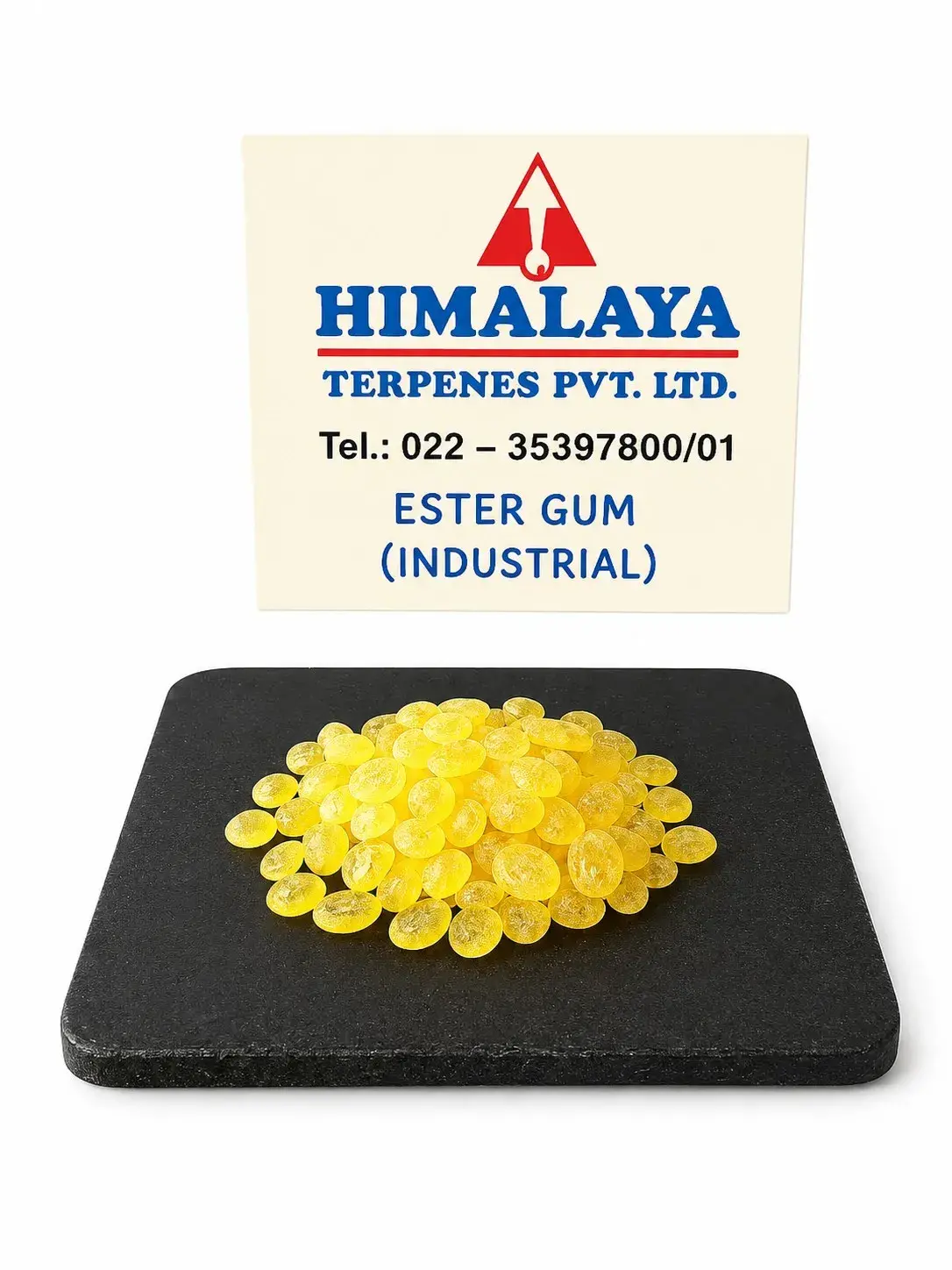
Ester Gum (Food) (CAS 8050-31-5) is a ester gum manufactured by Himalaya Terpenes Pvt. Ltd. at its ISO 9001:2015-certified plant in Mumbai, India. Glyceryl Rosinate — also called Glycerol Ester of Gum Rosin (GEGR) or Ester Gum — is an oil-soluble food additive valued for its density, which lets it keep flavour oils evenly suspended in water-based drinks. It is supplied in bulk in 3 grades for domestic and export orders, packaged as fiber drum made to order. Request a quote or PDS/MSDS via the contact form.
Description
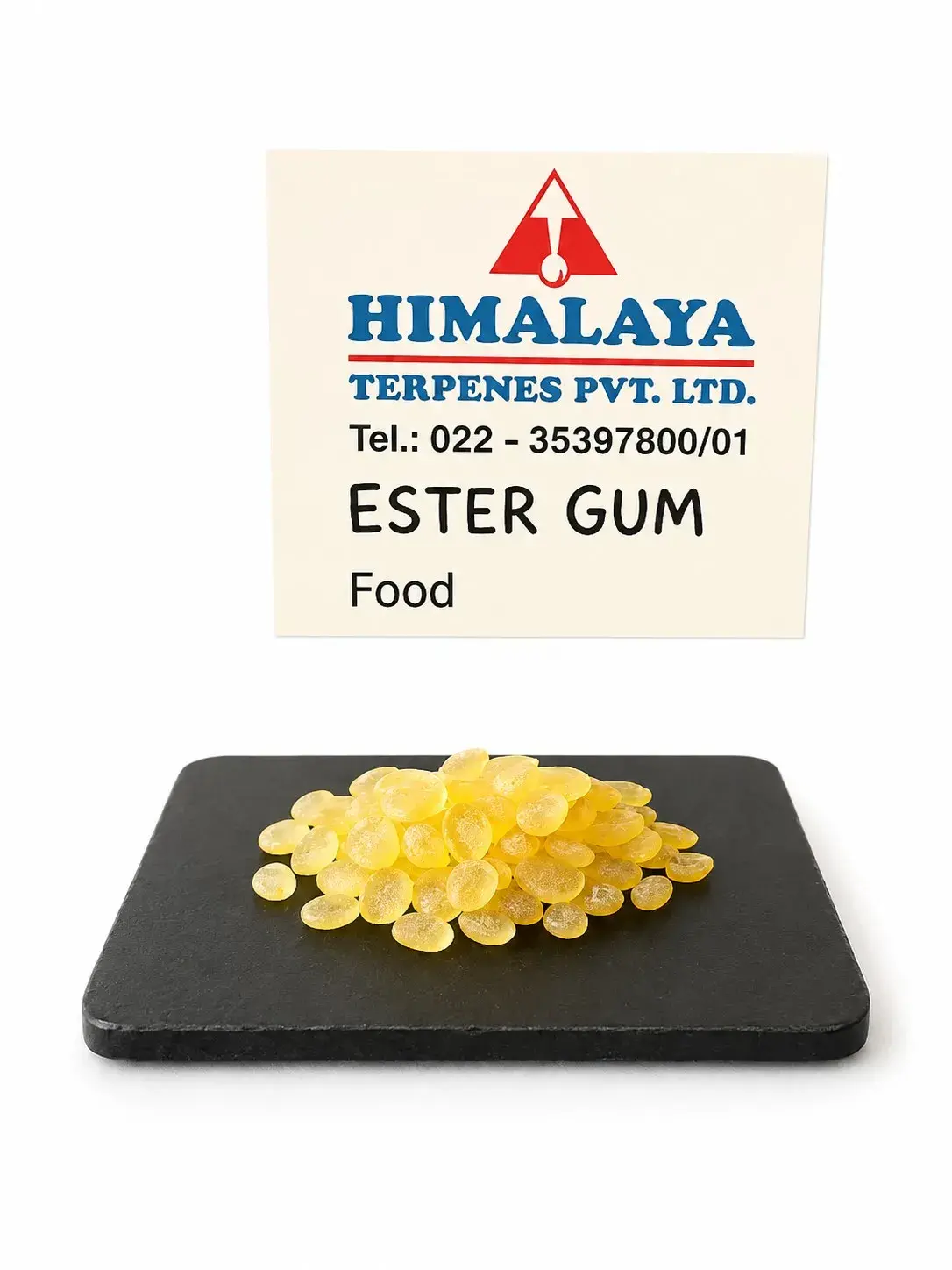
Glyceryl Rosinate — also called Glycerol Ester of Gum Rosin (GEGR) or Ester Gum — is an oil-soluble food additive valued for its density, which lets it keep flavour oils evenly suspended in water-based drinks. That property makes it a common beverage stabiliser for maintaining consistency in food and beverage formulations.
In food manufacturing it is widely used as a base ingredient in chewing gum, and it can replace or supplement brominated vegetable oil (BVO) as an emulsifier in citrus-flavoured soft drinks.
It carries approval from major regulatory bodies, including FDA 172.735 and EU Regulation No 231/2012, confirming its acceptability as a food additive, and it can additionally act as an antioxidant and softening agent in SBR- or polyvinyl-acetate-based chewing gum.
Documents & Quote
Specifications
| HS Code | 3806.30 |
| Molecular Formula | N/A |
| Molecular Weight | N/A |
| Colour | 7 to 8 |
| Softening Point | 82 to 90 |
| Heavy metals | 20 max |
| Acid Value | 3 to 8 |
| Arsenic | 2 max |
| Ash | 0.1 max |
| Solubility | Clear |
| Package | Fiber Drum made to order | Inner Aluminum Foil Vacuum Complex Bag, 25 kg net each | Paper-plastic compound bag, 25 kg net each, 640 bags (16,000 kg, 20 pallets per 20' FCL) | Paper Carton, 25 kg net each, 780 cartons (19,500 kg, 20 pallets per 20' FCL) | Woven Bag, 500 kg net each |
Application & Uses
-
Chewing Gum Production: Functions as an antioxidant and softening agent in SBR or polyvinyl acetate-based chewing gum and bubble gum, in line with FDA 172.615.
-
Beverage Stabiliser: Stabilises emulsions in soft drinks, keeping oil evenly suspended in citrus-flavoured beverages.
-
Cosmetics & Depilatory: Acts as a tackifier that improves texture and adhesion in cosmetic and depilatory products.
-
Fertiliser & Pesticide Formulations: Applied as a urea fertiliser coating for tobacco crops and used as a thixotropic agent in pesticide dispersions.
FAQ
What is Ester Gum and what is it used for?
Ester Gum (Glyceryl Rosinate / Glycerol Ester of Gum Rosin) is a rosin-based polyol ester used as a food additive/stabiliser in the food grade, and as an adhesive tackifier or polymer/coating modifier in the industrial grades.
What are the main industrial applications of Ester Gum?
The food grade works as a beverage stabiliser and chewing gum base; the adhesives grade improves tack in hot-melt and pressure-sensitive adhesives; the industrial grade supports paint/coating resins and polymer systems like EVA, acrylics, polyurethanes, SIS and SBS.
How is Ester Gum manufactured from Gum Rosin?
It's produced by esterifying gum rosin with glycerol, yielding a polyol ester with improved oxidative stability and compatibility compared to raw rosin.
What is the difference between Ester Gum and Gum Rosin?
Gum Rosin is the raw pine resin material, while Ester Gum is its glycerol ester — a chemically modified, more stable derivative suited to food, adhesive and coating applications that raw rosin isn't well suited for.
Which industries use Ester Gum?
Food and beverage manufacturers (food grade), adhesive producers, and paint/coating and polymer manufacturers.
How does Ester Gum improve adhesion and formulation performance?
Its resin character boosts tack, compatibility and formulation flexibility in hot-melt and pressure-sensitive adhesives, and contributes desirable processing and performance characteristics in polymer and coating systems.
What grades and specifications of Ester Gum are available?
Food grade (colour 7–8, softening point 82–90°C), Adhesives grade and Industrial grade (colour 2–4, softening point 98–102°C) — all specified by colour, softening point, acid value and solubility.
What properties should buyers evaluate when selecting Ester Gum?
Colour, softening point, acid value, and solubility in benzene, matched to whether the application is food, adhesive or industrial coating/polymer use.
How should Ester Gum be stored and packaged?
Store in a cool, dry place away from moisture and direct sunlight, in tightly sealed containers; typically supplied in fiber drums, paper-plastic bags, cartons or woven bags depending on grade.
How is Ester Gum used in adhesives, coatings, inks, and other formulations?
It acts as a tackifier and modifier that improves tack, adhesion, gloss and compatibility across hot-melt/PSA adhesives, phenolic resin paints, and various polymer coating systems.
How do the Food, Adhesives and Industrial grades of Ester Gum differ?
All three are glycerol esters of rosin. The Food grade is made to food-additive purity for uses such as beverage emulsions and chewing-gum base, the Adhesives grade is optimised for tack and compatibility in pressure-sensitive and hot-melt adhesives, and the Industrial grade is a general-purpose tackifier and binder for coatings, inks and rubber where food compliance is not needed.
Who supplies Ester Gum (Food) in bulk?
Himalaya Terpenes Pvt. Ltd. (Mumbai, India) supplies Ester Gum (Food) in bulk, in drums, bags, IBCs or ISO tanks depending on the grade, for domestic and export orders. The company is an ISO 9001:2015-certified pine-chemical manufacturer operating since 1971.
Is ester gum used in drinks?
Yes. Food-grade ester gum (glycerol ester of rosin, INS 445 / E445) is used as a weighting agent in citrus and other flavoured soft drinks, keeping flavour oils evenly dispersed so the drink does not separate or form a ring at the neck. It is also used in chewing-gum bases. Its use is governed by the food regulations of each country.
What is the difference between glycerol ester of gum rosin and glycerol ester of wood rosin?
Both are glycerol esters of rosin, made by reacting rosin with glycerol, and both are covered by food additive INS 445 / E445. The difference is the source of the rosin: gum rosin is obtained by tapping living pine trees, while wood rosin is extracted from aged pine stumps. Himalaya Terpenes manufactures its ester gum from gum rosin.
What is the price of food grade ester gum?
The price of food grade ester gum changes with raw-material costs and depends on grade, order quantity, packing and delivery location, so Himalaya Terpenes quotes per order rather than publishing a fixed price. Share your required grade, quantity and destination through our contact page for a current bulk quotation.
More from Ester Gum
Related Products
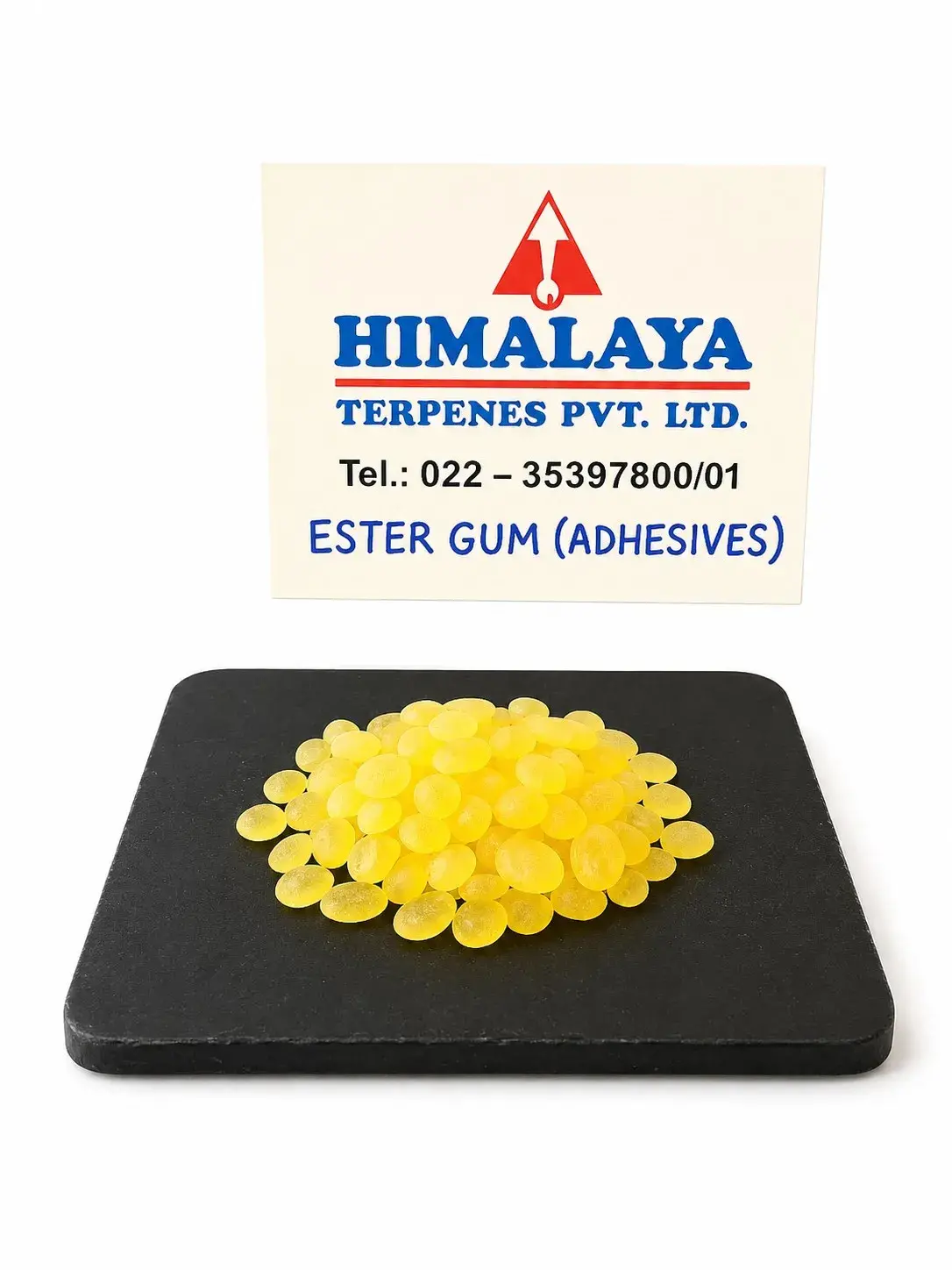
Ester Gum (Adhesives)
View Details