Pine Oil: Uses, Properties, and Applications in Different Industries
Himalaya Terpenes Pvt. Ltd.
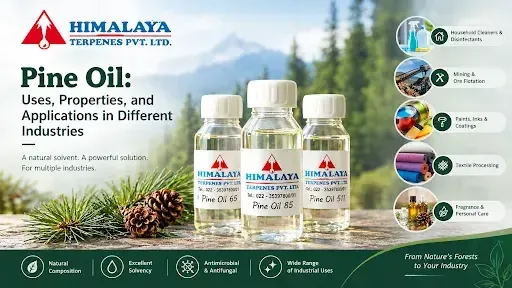
Pine oil is a flexible essential oil made mainly from pine trees (Pinus sylvestris and related species) by steaming pine needles, twigs, or stumps, or by treating alpha-pinene taken from gum turpentine. Known for its fresh forest smell, strong ability to dissolve substances, and natural germ-fighting qualities, pine oil is an important raw material used in everyday products, heavy industry, and manufacturing.
Key Properties of Pine Oil
Pine oil’s broad utility stems from a unique physical and chemical profile:
- High Terpene Alcohol Content: It mainly contains alpha-terpineol, along with hydrocarbons and other terpene alcohols like alpha-pinene, beta-pinene, and dipentene. The amount of alcohol in it decides its commercial quality (for example, 50%, 65%, 85%, or perfume-grade).
- Solvent Qualities: Pine oil is an effective organic solvent and can be used to dissolve greases, resins, oils, fats and waxes.
- Antimicrobial & Antifungal Properties: It has natural bacteriostatic, fungicidal and mildew-resistant properties.
- Surfactant & Emulsifying Properties: It reduces surface tension, so it improves a liquid’s ability to both wet and create foam.
- Physical Profile & Appearance: It is a clear to pale yellow liquid with a strong, long-lasting pine scent.
Industry Specifications Summary
- CAS Number: 8000-41-7 / 8002-09-3
- Boiling Point: 170°C to 225°C
- Flash Point: 50°C to 88°C (varies by grade)
- Relative Density: ~0.860 – 0.925 g/mL @ 25°C
Major Industrial Applications
1. Household Cleaners & Disinfectants
The household cleaning sector represents the single largest consumer of pine oil.
- Disinfection: Acts as an active or secondary germicidal agent in floor cleaners, surface sprays, and commercial sanitizers.
- Degreasing: Cuts through stubborn kitchen grease, soap scum, and industrial grime.
- Fragrance Masking: Leaves behind a natural forest scent that masks harsher chemical bases.
2. Mining & Ore Flotation
In mineral processing, pine oil is widely used as a frothing agent during froth flotation. Its controlled foaming action forms stable air bubbles in water slurries, allowing hydrophobic mineral particles such as copper, lead, zinc, and gold to attach to the bubbles and float to the surface, separating them from waste rock (gangue).
3. Paints, Inks, and Coatings
Pine oil is used as a solvent and additive within industrial paint, enamel and print inks.
- Flow & Leveling: Assists paint in flowing, evening out the finish and avoiding brush stippling. It also promotes even drying.
- Resin Solvent: Dissolves man-made resins and premium print inks.
- Anti-Foam & Wetting: Promotes pigment wetting and avoids foam formation when mixing.
4. Textile Processing
Utilized as a processing aid during fabric preparation and dyeing:
- Penetrant: Allows even colour application by increasing dye penetration through thick fibres.
- Scouring Agent: Removes natural grease, wax and oils from natural fibres ahead of dyeing and finishing.
5. Aromatherapy, Fragrance & Personal Care
Fractionated pine oil and alpha-terpineol are also used within personal care items.
- Fragrance Base: Used as a head note in pine-scented soaps, laundry detergents, body wash and room fragrance.
- Aromatherapy: Used within diffusers to both purify and invigorate.
Commercial Grades and Manufacturers
Pine oil is typically traded in standard grades based on its terpene alcohol content, including Pine Oil 50, Pine Oil 65, Pine Oil 70 and Pine Oil 85, along with lighter grades such as Pine Oil 211, 311, 411 and 511. Specialty pine chemical producers, such as Himalaya Terpenes, supply these standardized industrial grades globally.
Need this product in bulk?
Our sales team can share specifications, PDS/MSDS and a quote.